Funding Explainer
Measure L vs. Measure W
Two separate measures from two separate districts — what each one would do, in plain language.
- Status
- Published
- Last updated
- 2026-08-24
- Sources
The question I had as a mom
“What are these two school funding measures, who governs each one, and what would each actually do?”
One Walnut Creek family, two school districts
Measure L and Measure W are not two versions of the same tax. They are two separate measures from two separate districts, placed on the ballot by two separate governing boards.
Unlike most California school districts — which run one K-12 system from kindergarten through 12th grade — Walnut Creek is split across separate, independently governed districts. Walnut Creek School District (WCSD) runs TK-8 only; Walnut Creek's high schoolers then attend Las Lomas, part of the separate Acalanes Union High School District (AUHSD). That split isn't unique to Walnut Creek, but it does mean two boards, two budgets, and — this year — two separate ballot measures.
There's a real advantage to this structure: each board specializes. WCSD's elected trustees focus only on elementary and middle-school needs — reading foundations, TK class sizes, middle-school electives — while AUHSD's trustees focus only on the high-school program: AP and career-tech offerings, college counseling, a four-campus footprint. Neither board is trying to run both at once.
Which addresses are affected: Most Walnut Creek addresses sit in WCSD for TK-8 and AUHSD for 9-12, so they are affected by both districts' measures. A few Walnut Creek addresses are zoned to Mount Diablo Unified (a K-12 district) instead — those addresses are not affected by Measure L or Measure W. Confirm your own schools with the district office or the Contra Costa County Office of Education.

Walnut Creek School District
TK-8 · Measure L · failed June 2, 2026

Buena Vista
Elementary

Indian Valley
Elementary

Murwood
Elementary

Parkmead
Elementary

Walnut Heights
Elementary

Walnut Creek Intermediate
Middle school

Acalanes Union High School District
9-12 · Measure W · Nov. 3, 2026 ballot

Las Lomas High School
The AUHSD high school that serves Walnut Creek

Acalanes

Campolindo

Miramonte
Share the same district funding pool
School lists from the campaign's compiled research. Attendance boundaries are address-specific — confirm which schools serve your home with WCSD and AUHSD directly.
What each measure would cost
Annual cost per parcel for each measure, next to WCSD's current baseline.
Annual parcel tax, dollars per year
Measure W would cost a typical parcel $168 per year — about 1.7× the failed Measure L rate, and roughly double WCSD's current $82 baseline. The campaign says this revenue would protect advanced math, science, engineering, and technology programs at Acalanes, Campolindo, Las Lomas, and Miramonte.
- Measure H: Still in effect, no expiration.
- Measure L: Would have stacked on Measure H ($180 combined) for teaching and instruction, adding ~$1.5M/yr for 9 years, with CPI adjustments capped at 3%. Unofficial results: ~64.7% yes (12,514 votes), 35.3% no (6,821 votes); 66.67% required. Confirm final certified results at contracostavote.gov.
- Measure W: Flat rate for 8 years, no inflation increases. Would add ~$5.5–6M/yr for high school programs and staffing. The campaign says this includes advanced math, science, engineering, and technology programs (official AUHSD ballot text pending).
65 or older, or receiving SSI/SSDI? Both measures included an exemption for senior homeowners and qualifying disability recipients. Measure W's exemption would be administered through AUHSD if the measure passes; Measure L's comparable exemption never took effect because the measure failed. Exemptions are not automatic — the official ballot text and district materials will define the exact application process.
What each measure would fund
Measure L's list comes from the official ballot text. Measure W's list comes from the Yes on W campaign one-pager (FPPC #1478885) — advocacy material, attributed as such.
Per the official ballot text, Measure L would have
- Attracted and retained qualified teachers
- Funded reading, writing, and language arts programs
- Funded math, science, engineering, and technology programs
- Funded music and arts instruction
- Kept technology and instructional materials up to date
- Maintained manageable class sizes
- Maintained safe, well-maintained facilities
Taxpayer safeguards listed
- Citizens' Oversight Committee
- Annual audits and reporting
- Restricted account (not the general fund)
- No funds for administrator salaries
- State/federal funding protection clause
This is the official ballot language from the Contra Costa County Elections Division, quoted directly — not a campaign's own framing, since no separate Measure L one-pager was located.
Per the campaign, Measure W would
- Maintain advanced programs in math, science, engineering, technology, and the arts
- Restore library services, academic counseling, and career training
- Provide career and technical education in biotech, medical/health sciences, auto mechanics, fabrication, and other skilled trades
- Keep technology up to date for modern student learning
- Provide instructional equipment, materials, and supplies
Safeguards the campaign lists
- All funds stay local
- A citizens' oversight committee
- Mandatory independent audits
- No funds for administrator salaries
Both lists are quoted from the Yes on W campaign's one-pager. The official AUHSD ballot text is the source of record once published.
How Measure L finished
Unofficial results as of June 25, 2026. The county's certified final count should be confirmed at contracostavote.gov before treating these as final.
June 2, 2026 results
64.7%
Yes · 12,514 votes
35.3%
No · 6,821 votes
Total counted: 19,335. The measure needed a two-thirds (66.67%) supermajority to pass.
What supporters and opponents said
- Supporters included Walnut Creek City Councilmember Cindy Silva.
- Proponents' central comparison: WCSD receives about $14,902 per student, versus an $18,705 Contra Costa County average.
- Opposition: Sandra Kallander, chair of the Libertarian Party of Contra Costa County, argued Walnut Creek already benefits from some of the highest per-pupil property tax revenue in the area.
Official ballot question
“Walnut Creek School District Quality Teaching/Academic Instruction Measure. Shall Walnut Creek School District's measure providing locally-controlled funding for quality academic programs in math, science, engineering, technology, reading, music/arts preparing students for high school, college, and careers; attract/retain qualified teachers; and maintain manageable class sizes by levying a $98 parcel tax for nine years, with senior exemptions, annual inflation adjustments, independent audits/oversight, and all funds (approximately $1,500,000 annually) benefiting local elementary and middle school students, be adopted?”
Source: Contra Costa County Elections Division, official measure wording.
Why these measures keep appearing: two elections, two failures
How WCSD and AUHSD arrived at the November 2026 ballot.
Before Measure W reached the ballot, voters in these two districts had already turned down two separate funding measures within about 13 months of each other:
- AUHSD's Measure T (May 6, 2025) — a parcel tax for the high school district — fell short of the required two-thirds vote.
- WCSD's Measure L (June 2, 2026) — the elementary/middle-school parcel tax detailed above — also fell short, despite getting roughly 65% yes.
Both included senior and SSI/SSDI disability exemptions; because both failed, neither exemption ever took effect.
AUHSD is now going back to voters with Measure W — a flat $168/parcel tax for 8 years (through roughly 2034), with no inflation adjustment, replacing the failed Measure T ask. Here's the part that's easy to miss if your kids are still in elementary school: Measure W's 8-year life means it would still be in effect when today's WCSD students reach Las Lomas. A current 3rd-grader crosses into AUHSD in about five years — while Measure W, if passed this November, would still have roughly three years left to run.
What happens if Measure W fails?
A failed measure doesn't cut anything by itself — it means new money never arrives. What the board does next is a decision voters can watch.
WCSD — Measure L already failed
Decided June 2, 2026
- The roughly $1.5M a year it would have raised never arrives.
- Funding continues on the existing $82-per-parcel Measure H baseline, in effect since 2009.
- The senior and disability exemptions written into Measure L never opened.
- The WCSD board could bring a revised measure back in a future election — no public board record of a planned re-vote has been found.
AUHSD — if Measure W fails
On the November 3, 2026 ballot
- Nothing changes on its own: the $168-per-parcel tax never takes effect, current funding continues, and the senior exemption never opens.
- The Yes on W campaign says AUHSD still operates at a structural deficit and warns that "without Measure W, more cuts are coming" — including pressure on the math, science, and career programs listed above.
- The AUHSD board could return to voters with a revised measure in a future election, as it did after Measure T fell short.
These are the campaign's own claims, quoted from its official one-pager. Read the one-pager directly.
Why is this even on the ballot? A quick note on California school funding
Context, not measure-specific detail — why so many California districts end up asking local voters directly.
Walnut Creek isn't unusual in going to voters for supplemental school funding — hundreds of California districts have done the same thing, and for a structural reason, not a local failure.
Proposition 13 (1978) capped how fast local property taxes could grow and shifted most school funding responsibility to the state. The state's funding formula — the Local Control Funding Formula (LCFF) — sets a base per-student grant plus extra money for districts with large shares of low-income, English-learner, homeless, or foster students. That formula covers a basic education, but it was never designed to fund the things many California families expect: art and music specialists, librarians, wellness centers, smaller class sizes, or robust STEM electives. Districts that don't have a large concentration of high-need students — WCSD among them — get comparatively little of the LCFF's supplemental funding, even in a high-cost area like Walnut Creek. (Proponents of Measure L pointed to WCSD receiving roughly $14,902 per student, versus an $18,705 Contra Costa County average — a gap this formula structure helps explain.)
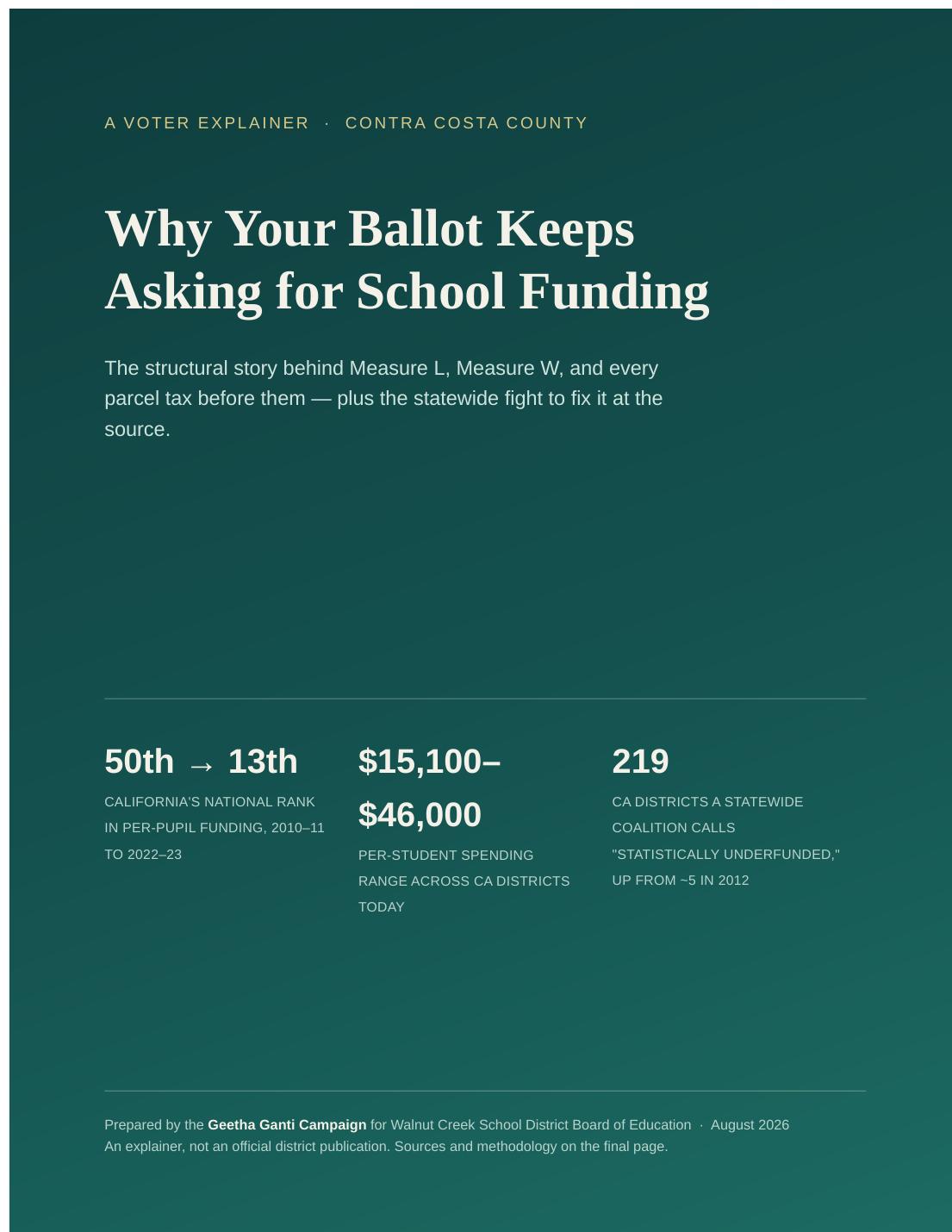
Statewide, California's overall per-pupil funding rank has genuinely improved — from 50th nationally in 2010-11 to 13th in 2022-23 (about $19,894/student) — but that jump leaned heavily on temporary, one-time pandemic-era funding and a strong stock-market-driven state budget, not a permanent fix to the base formula. And the state average masks wide swings underneath it: because of how property taxes and LCFF interact, California districts today range from about $15,100 to $46,000 per student — a gap driven far more by local property wealth than by student need.
California's national rank in per-pupil funding
50th
2010-11
37th
2017
28th
2021-22
13th
2022-23
Source: EdSource analysis of federal Census Bureau school finance data. The climb leans on one-time pandemic-recovery money and strong state revenue years, not a permanent base-formula change.
That gap is what a growing coalition of districts — organized as Raise the Base — is trying to fix. They point to a jump in the number of "statistically underfunded" California districts, from about 5 in 2012 to 219 in 2024 (an estimated 1.2 million students), and are pushing state lawmakers to adopt the Legislative Analyst's Office's recommended 7.24% increase to the LCFF base grant. It's a state-level policy fight, separate from local parcel-tax measures like L and W — but it's the same underlying gap that pushes districts like WCSD and AUHSD to ask local voters directly.
Raise the Base started with Buckeye Union School District's Dr. David Roth and has since been joined by Pleasanton and other Tri-Valley districts, parent groups, and PTAs. It's the second time in a decade California districts have organized around this argument: a similar coalition, Full and Fair Funding, filed a $15 billion statewide ballot measure in 2019, when California ranked 38th nationally, but shelved it before it reached voters. Raise the Base is narrower — aimed at the legislature, and anchored to a specific LAO-sourced number rather than a round dollar figure.
PDF explainer · 5 pages · 46 KB
Why Your Ballot Keeps Asking for School Funding
A short, illustrated walkthrough of how California school funding works, why local parcel taxes keep appearing, and where the numbers come from.
Source documents
Hover or tap a source for details. Every source has been located and reviewed before being cited; advocacy material is labeled as such.
Common questions
About this page
Plain language, sourced and attributed.
This explainer was compiled and organized by the Geetha Ganti Campaign for Your Education — because we believe families deserve clear, honest information about what's on their ballot, not campaign slogans.
It is not an official district publication. The official ballot text and district materials are the source of record. Where we quote the Yes on W campaign, we say so. Where we don't know something, we say that too.
Our goal is to make the system understandable — not to tell you how to vote. If something here helps you ask a better question at a board meeting, we've done our job.
This is exactly the kind of plain-language transparency I want to bring to school board decisions.
Read my transparency priority — and see how I'd make district budgets, ballot measures, and major decisions easier for every parent to follow.
What could change?
No page on this site promises outcomes that depend on future funding, district staff, collective board decisions, or circumstances that cannot yet be known. Here is what would remain undecided — and who would decide it.
Decisions that remain with the board
- Whether the WCSD board proposes a future revenue measure after Measure L's failure — and on what terms, amount, and timing
- How WCSD allocates its existing $82-per-parcel Measure H revenue, budget by budget
- If Measure W passes, every allocation decision belongs to the AUHSD governing board — a separate body from WCSD's
Delegated to district administration
- How any funded positions and programs would be staffed, scheduled, and managed day to day in each district
- How spending against each measure's categories would be tracked and publicly reported
Depends on teachers & school staff
- Delivering any funded programs in classrooms depends on teachers and site staff in each district
Funding assumptions
- Revenue figures (~$1.5M/year for Measure L; ~$5.5–6M/year for Measure W) are estimates — actual revenue depends on parcel counts and exemptions
- WCSD's current baseline is only the $82-per-parcel Measure H tax from 2009, which has no inflation adjustment and loses purchasing power over time
Enrollment assumptions
- Enrollment shifts change program costs and staffing needs in both districts over the life of any measure
State & federal dependencies
- State and federal funding decisions shape both districts' budgets; Measure L included a clause reducing the tax if it caused a cut to state or federal funding elsewhere
Known risks
- The $4.2M in AUHSD cuts and the per-pupil funding comparison cited for Measure W come from the Yes on W campaign — advocacy material not independently verified here
- Measure L's failure leaves the needs it described unfunded unless the WCSD board finds other revenue
- Measure W has no inflation adjustment, so its flat $168 rate would lose purchasing power each year it is in effect
Questions still unanswered
- Does the WCSD board plan to return to voters with a revised measure after Measure L's failure? No public board record of a planned re-vote has been found.
- When will AUHSD's official Measure W ballot text and impartial analysis be published for side-by-side verification?
- How will WCSD address the needs Measure L was intended to fund, now that it has failed?
This is the campaign's language standard in practice: "will" is reserved for what Geetha can personally and directly control — asking for data, explaining trade-offs, making her reasoning public. Everything else is described as what she would advocate for, prioritize, or evaluate — never as a guarantee.